
MCA Iftar Gathering 2026

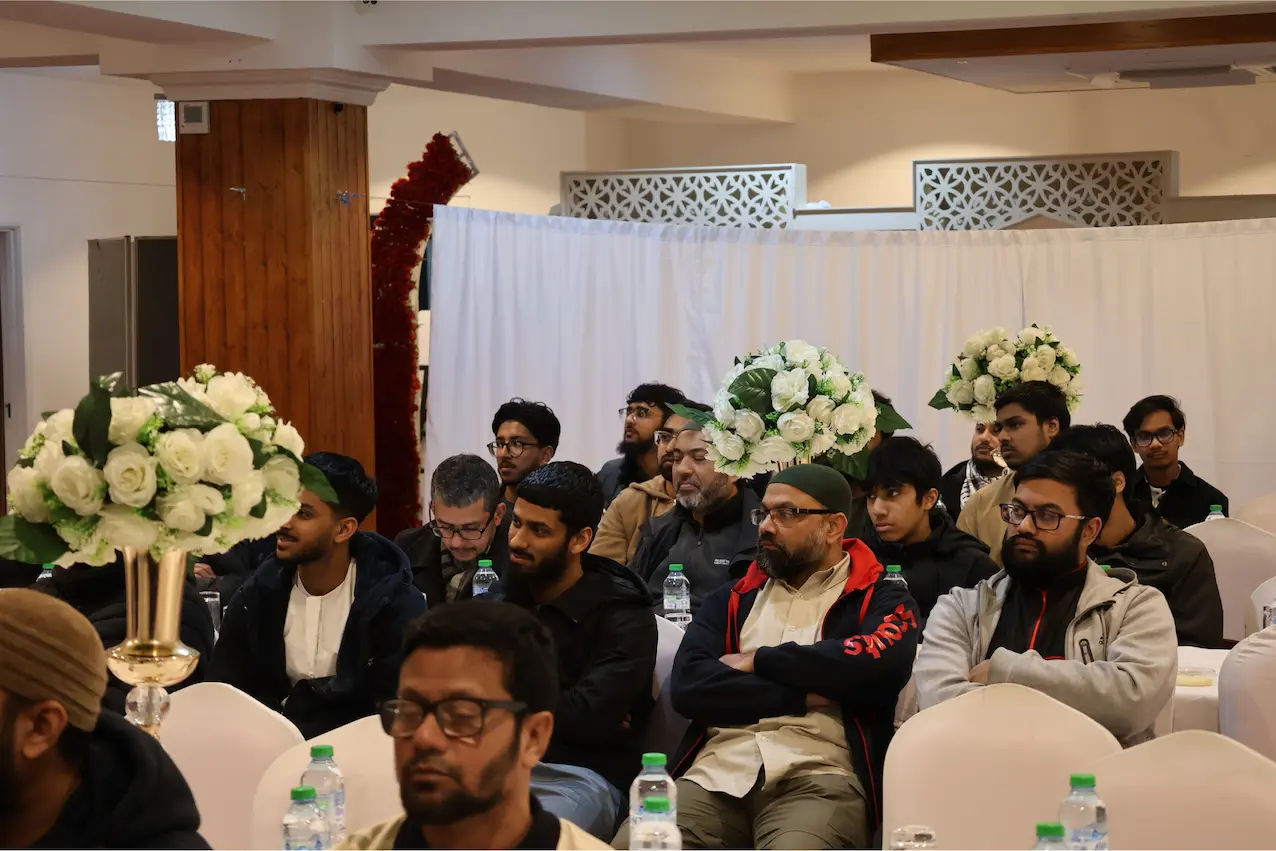
The Muslim Community Association (Nectar and Elevate Regions) held an iftar gathering with students and professionals on 28 February 2026 at the Maedah Banqueting Hall. Around 100 people attended the gathering. The theme of the iftar gathering was Muslims in Britain: The Past, Present and Future.
Br Azad Miah, President of MCA Nectar Region welcomed everyone to the event and reminded everyone about the purpose of fasting in the month of Ramadan. The programme was conducted by Br Shahed Ahmed (MCA Elevate Region Secretary) and Br Azizur Rahman Shakir (MCA Nectar Region Secretary) conducted the iftar event.
Dr Muhammad Abdul Bari spoke on the Evolution of British Muslim Community. He mentioned that
“There is evidence that Britain had contact with the Muslim from the 7th century. King Offa of Mercia minted a coin with the Shahada. However, our presence here in Britain is because of a painful history. Our forefathers were colonised by the forefathers of the native people of Britain. We should not forget this fact.”
He mentioned that there was a small Muslim community of several hundred Muslims in the late 19th and early 20th Century. Large numbers started to immigrate to Britain after the 2nd World war when Britain invited labour from its former colonies to rebuild the country. Families started to come mainly in the 70s and 80s and Muslim community started to build important institutions. As the number of Muslims increased in Britain, Islamophobia started surfacing in the early 90s and increased significantly after 9/11 and 7th July 2005.
Dr Wajid Akhter, Secretary General of MCB spoke about the importance making positive contribution in the society especially by our younger generations. He said that our forefathers struggled with their limited resources but built the institutions for us. We cannot be complacent and indifferent to what is happening in the society. He said addressing the audience of mainly young professionals that
“what your children will care about is what you did for other people, what you achieved, what you gave to this Ummah. That’s what they are going to be proud about. The money you leave behind will be distributed very quickly.”
He concluded his speech by highlighting the cycle of society that
“difficult times lead to strong men, strong men lead to good times and good times lead to weak men and weak men lead to difficult times again.”
Dr Mohammed Abdul Aziz in his presentation mentioned the challenge of the future of the Muslim community. He focused on one immediate challenge which is the challenge of the far-right and right-wing parties. He said there is a high possibility that a right wing party will come to power within 3 years and they will curtail many religious and human rights we enjoy in Britain. He said that
“they will take us out of the European Convention of Human Rights, which means that many of the protections that we have will be downgraded.”
He said that some of the ways of dealing with the challenges are to engage in mainstream politics, engage effectively with the media and open our Mosques and institutions for the benefit of the wider society.
Barrister Hamid Azad, Central President of MCA, made the concluding remarks in the iftar gathering. He thanked the speakers for their valuable contribution and encouraged the audience to reflect on the speeches. He addressed the audience by saying,
“our older generations build the structures, you have the capacity to utilise the structures by unleashing your potentials. You have the potentials to make this world a happy world. You are seeing what is happening in the Middle East. You are the people, you are the leaders who can bring hope.”
MCA Nectar and Elevate Regions Host Iftar Gathering for Students and Professionals
The Muslim Community Association (MCA) Nectar and Elevate Regions hosted a special iftar gathering for students and professionals on 28 February 2026 at Maedah Banqueting Hall. Around 100 attendees joined the event, which was organised around the theme “Muslims in Britain: The Past, Present and Future.”
The programme began with recitation by a guest Ramadan Imam of East London Mosque, Shaykh Mutaz Ghanam and a welcome address from Br Azad Miah, President of MCA Nectar Region. In his remarks, he warmly welcomed the guests and reminded attendees about the spiritual purpose and significance of fasting during the blessed month of Ramadan.
The programme was jointly conducted by Br Shahed Ahmed, Secretary of MCA Elevate Region, and Br Azizur Rahman Shakir, Secretary of MCA Nectar Region.
Evolution of the British Muslim Community
The first keynote speaker, Dr Muhammad Abdul Bari, spoke about the evolution of the British Muslim community. He highlighted that historical evidence suggests contact between Britain and Muslims dates back to the 8th century, citing the example of King Offa of Mercia, who minted a coin bearing the Shahada.
Dr Bari noted that the modern Muslim presence in Britain is closely linked to the country’s colonial past.
“Our presence here in Britain is because of a painful history. Our forefathers were colonised by the forefathers of the native people of Britain. We should not forget this fact.”
He explained that in the late 19th and early 20th centuries, Britain had only a small Muslim population numbering several hundred. Large-scale migration began after the Second World War, when Britain invited workers from former colonies to help rebuild the country. During the 1970s and 1980s, families began settling in larger numbers, leading to the establishment of mosques, community organisations, and other important institutions.
Dr Bari also highlighted that as the Muslim population grew, Islamophobia began to emerge more prominently during the early 1990s, increasing significantly after 9/11 and the 7 July 2005 London attacks.
Contributing Positively to Society
The second speaker, Dr Wajid Akhter, Secretary General of the Muslim Council of Britain (MCB), emphasised the importance of making a positive contribution to wider society, particularly among younger generations.
He reminded the audience that earlier generations worked tirelessly, often with limited resources, to establish institutions that benefit the community today.
“Our forefathers struggled with their limited resources but built the institutions for us. Now, we cannot be complacent or indifferent to what is happening in society.”
Addressing the largely young professional audience, he encouraged them to focus on service and contribution:
“What your children will care about is what you did for other people, what you achieved, and what you gave to this Ummah. That is what they will be proud of. The money you leave behind will be distributed very quickly.”
Dr Akhter concluded by reflecting on the cyclical nature of societies:
“Difficult times lead to strong people, strong people lead to good times, good times lead to weak people, and weak people lead to difficult times again.”
Challenges Facing the Future
In his presentation, Dr Mohammed Abdul Aziz discussed future challenges facing the Muslim community in Britain. He highlighted the rise of far-right and right-wing political movements as a significant concern.
He suggested that there is a possibility that a right-wing party could come to power in the coming years, potentially affecting religious and civil liberties currently enjoyed in Britain.
“They may take the country out of the European Convention on Human Rights, which means many of the protections that we currently have could be reduced.”
Dr Aziz emphasised that the community must respond proactively to these challenges. He suggested several important approaches, including:
· Greater engagement in mainstream politics
· More effective engagement with the media
· Opening mosques and community institutions for the benefit of wider society.
Concluding Remarks
The programme concluded with remarks from Barrister Hamid Azad, Central President of MCA. He thanked the speakers for their valuable insights and encouraged the audience to reflect on the messages shared during the evening.
Addressing the young attendees, he said:
“Our older generations built the structures. You have the capacity to utilise those structures by unleashing your potential. You have the ability to make this world a happier place. You are witnessing what is happening in the Middle East. You are the people—the leaders—who can bring hope.”
The gathering provided a valuable opportunity for reflection, networking, and inspiration for the next generation of Muslim professionals and leaders.